
diff options
Diffstat (limited to 'home/.oh-my-zsh/plugins/dircycle')
| -rw-r--r-- | home/.oh-my-zsh/plugins/dircycle/README.md | 82 | ||||
| -rw-r--r-- | home/.oh-my-zsh/plugins/dircycle/dircycle.plugin.zsh | 87 |
2 files changed, 169 insertions, 0 deletions
diff --git a/home/.oh-my-zsh/plugins/dircycle/README.md b/home/.oh-my-zsh/plugins/dircycle/README.md new file mode 100644 index 0000000..c410555 --- /dev/null +++ b/home/.oh-my-zsh/plugins/dircycle/README.md @@ -0,0 +1,82 @@ +# dircycle + +Plugin for cycling through the directory stack + +This plugin enables directory navigation similar to using back and forward on browsers or common file explorers like Finder or Nautilus. It uses a small zle trick that lets you cycle through your directory stack left or right using <kbd>Ctrl</kbd> + <kbd>Shift</kbd> + <kbd>Left</kbd> / <kbd>Right</kbd> . This is useful when moving back and forth between directories in development environments, and can be thought of as kind of a nondestructive pushd/popd. + +## Enabling the plugin + +1. Open your `.zshrc` file and add `dircycle` in the plugins section: + + ```zsh + plugins=( + # all your enabled plugins + dircycle + ) + ``` + +2. Restart the shell or restart your Terminal session: + + ```console + $ exec zsh + $ + ``` + +## Usage Examples + +Say you opened these directories on the terminal: + +```console +~$ cd Projects +~/Projects$ cd Hacktoberfest +~/Projects/Hacktoberfest$ cd oh-my-zsh +~/Projects/Hacktoberfest/oh-my-zsh$ dirs -v +0 ~/Projects/Hacktoberfest/oh-my-zsh +1 ~/Projects/Hacktoberfest +2 ~/Projects +3 ~ +``` + +By pressing <kbd>Ctrl</kbd> + <kbd>Shift</kbd> + <kbd>Left</kbd>, the current working directory or `$PWD` will be from `oh-my-zsh` to `Hacktoberfest`. Press it again and it will be at `Projects`. + +And by pressing <kbd>Ctrl</kbd> + <kbd>Shift</kbd> + <kbd>Right</kbd>, the `$PWD` will be from `Projects` to `Hacktoberfest`. Press it again and it will be at `oh-my-zsh`. + +Here's a example history table with the same accessed directories like above: + +| Current `$PWD` | Key press | New `$PWD` | +| --------------- | ----------------------------------------------------- | --------------- | +| `oh-my-zsh` | <kbd>Ctrl</kbd> + <kbd>Shift</kbd> + <kbd>Left</kbd> | `Hacktoberfest` | +| `Hacktoberfest` | <kbd>Ctrl</kbd> + <kbd>Shift</kbd> + <kbd>Left</kbd> | `Projects` | +| `Projects` | <kbd>Ctrl</kbd> + <kbd>Shift</kbd> + <kbd>Left</kbd> | `~` | +| `~` | <kbd>Ctrl</kbd> + <kbd>Shift</kbd> + <kbd>Right</kbd> | `Projects` | +| `Projects` | <kbd>Ctrl</kbd> + <kbd>Shift</kbd> + <kbd>Right</kbd> | `Hacktoberfest` | +| `Hacktoberfest` | <kbd>Ctrl</kbd> + <kbd>Shift</kbd> + <kbd>Right</kbd> | `oh-my-zsh` | +| `oh-my-zsh` | <kbd>Ctrl</kbd> + <kbd>Shift</kbd> + <kbd>Right</kbd> | `~` | + +Note the last traversal, when pressing <kbd>Ctrl</kbd> + <kbd>Shift</kbd> + <kbd>Right</kbd> on a last known `$PWD`, it will change back to the first known `$PWD`, which in the example is `~`. + +Here's an asciinema cast demonstrating the example above: + +[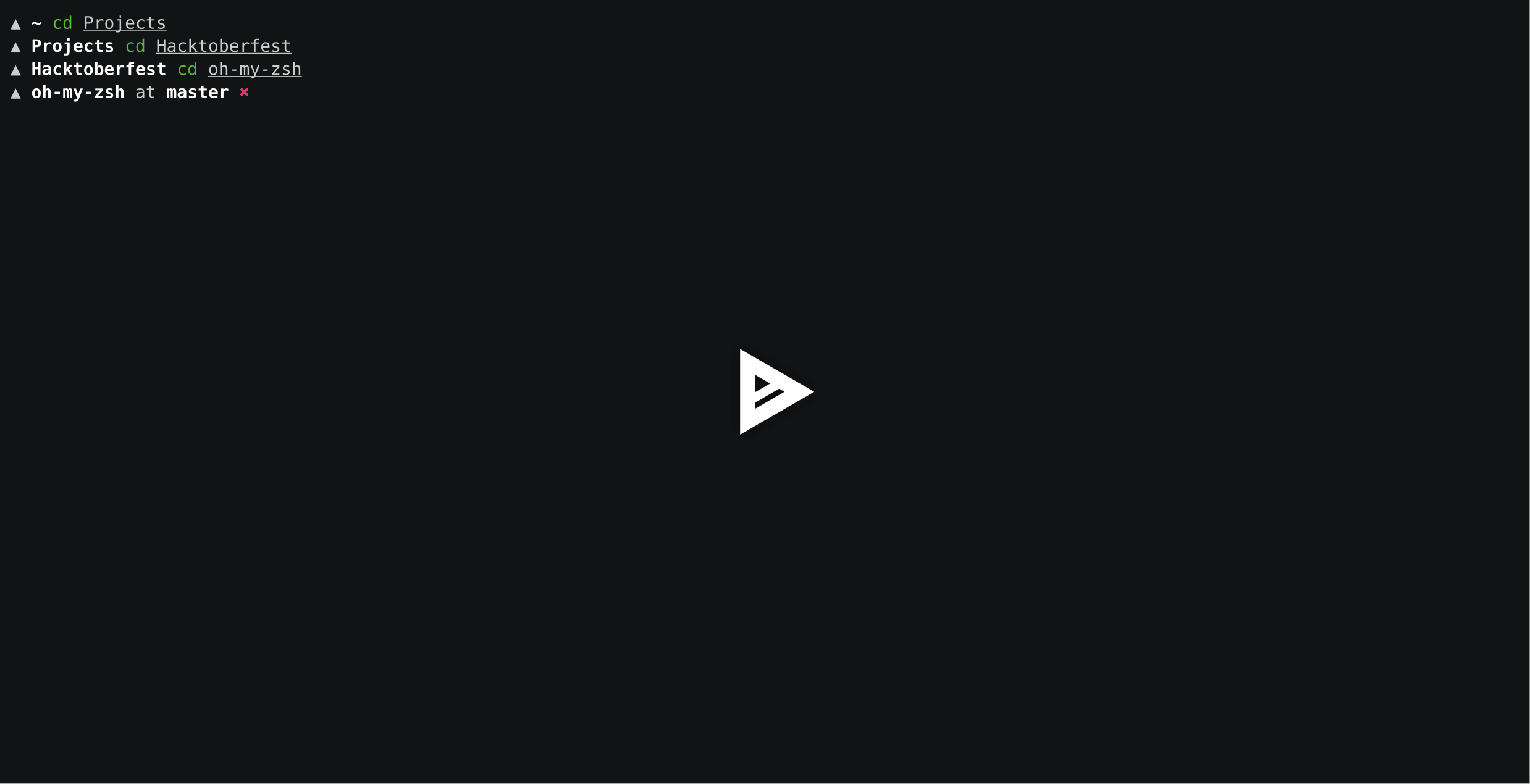](https://asciinema.org/a/204406) + +## Functions + +| Function | Description | +| -------------------- | ------------------------------------------------------------------------------------------------------------------- | +| `insert-cycledleft` | Change `$PWD` to the previous known stack, bound to <kbd>Ctrl</kbd> + <kbd>Shift</kbd> + <kbd>Left</kbd> | +| `insert-cycledright` | Change `$PWD` to the next known stack, bound to <kbd>Ctrl</kbd> + <kbd>Shift</kbd> + <kbd>Right</kbd> | +| `insert-cycledup` | Change `$PWD` to the parent folder, bound to <kbd>Ctrl</kbd> + <kbd>Shift</kbd> + <kbd>Up</kbd> | +| `insert-cycleddown` | Change `$PWD` to the first alphabetical child folder, bound to <kbd>Ctrl</kbd> + <kbd>Shift</kbd> + <kbd>Down</kbd> | + +## Rebinding keys + +You can bind these functions to other key sequences, as long as you know the bindkey sequence. For example, these commands bind to <kbd>Alt</kbd> + <kbd>Shift</kbd> + <kbd>key</kbd> in `xterm-256color`: + +```zsh +bindkey '^[[1;4D' insert-cycledleft +bindkey '^[[1;4C' insert-cycledright +bindkey "\e[1;4A" insert-cycledup +bindkey "\e[1;4B" insert-cycleddown +``` + +You can get the bindkey sequence by pressing <kbd>Ctrl</kbd> + <kbd>V</kbd>, then pressing the keyboard shortcut you want to use. diff --git a/home/.oh-my-zsh/plugins/dircycle/dircycle.plugin.zsh b/home/.oh-my-zsh/plugins/dircycle/dircycle.plugin.zsh new file mode 100644 index 0000000..8c03594 --- /dev/null +++ b/home/.oh-my-zsh/plugins/dircycle/dircycle.plugin.zsh @@ -0,0 +1,87 @@ +# enables cycling through the directory stack using +# Ctrl+Shift+Left/Right +# +# left/right direction follows the order in which directories +# were visited, like left/right arrows do in a browser + +# NO_PUSHD_MINUS syntax: +# pushd +N: start counting from left of `dirs' output +# pushd -N: start counting from right of `dirs' output + +# Either switch to a directory from dirstack, using +N or -N syntax +# or switch to a directory by path, using `switch-to-dir -- <path>` +switch-to-dir () { + # If $1 is --, then treat $2 as a directory path + if [[ $1 == -- ]]; then + # We use `-q` because we don't want chpwd to run, we'll do it manually + [[ -d "$2" ]] && builtin pushd -q "$2" &>/dev/null + return $? + fi + + setopt localoptions nopushdminus + [[ ${#dirstack} -eq 0 ]] && return 1 + + while ! builtin pushd -q $1 &>/dev/null; do + # We found a missing directory: pop it out of the dir stack + builtin popd -q $1 + + # Stop trying if there are no more directories in the dir stack + [[ ${#dirstack} -eq 0 ]] && return 1 + done +} + +insert-cycledleft () { + switch-to-dir +1 || return $? + + local fn + for fn in chpwd $chpwd_functions precmd $precmd_functions; do + (( $+functions[$fn] )) && $fn + done + zle reset-prompt +} +zle -N insert-cycledleft + +insert-cycledright () { + switch-to-dir -0 || return $? + + local fn + for fn in chpwd $chpwd_functions precmd $precmd_functions; do + (( $+functions[$fn] )) && $fn + done + zle reset-prompt +} +zle -N insert-cycledright + +insert-cycledup () { + switch-to-dir -- .. || return $? + + local fn + for fn in chpwd $chpwd_functions precmd $precmd_functions; do + (( $+functions[$fn] )) && $fn + done + zle reset-prompt +} +zle -N insert-cycledup + +insert-cycleddown () { + switch-to-dir -- "$(find . -mindepth 1 -maxdepth 1 -type d | sort -n | head -n 1)" || return $? + + local fn + for fn in chpwd $chpwd_functions precmd $precmd_functions; do + (( $+functions[$fn] )) && $fn + done + zle reset-prompt +} +zle -N insert-cycleddown + +# These sequences work for xterm, Apple Terminal.app, and probably others. +# Not for rxvt-unicode, but it doesn't seem differentiate Ctrl-Shift-Arrow +# from plain Shift-Arrow, at least by default. +# +# iTerm2 does not have these key combinations defined by default; you will need +# to add them under "Keys" in your profile if you want to use this. You can do +# this conveniently by loading the "xterm with Numeric Keypad" preset. +bindkey "\e[1;6D" insert-cycledleft # Ctrl+Shift+Left +bindkey "\e[1;6C" insert-cycledright # Ctrl+Shift+Right +bindkey "\e[1;6A" insert-cycledup # Ctrl+Shift+Up +bindkey "\e[1;6B" insert-cycleddown # Ctrl+Shift+Down |